The Global Flourishing Study (GFS) is a multi-year longitudinal research collaboration between researchers at the Institute for Studies of Religion at Baylor University and the Human Flourishing Program at Human Flourishing Program at Harvard University, in partnership with Gallup and the Center for Open Science (COS), and with the support of a consortium of funders. Data is collected for 20+ geographically and culturally diverse countries and territories, including Argentina, Australia, Brazil, Mainland China, Egypt, Germany, India, Indonesia, Israel, Japan, Kenya, Mexico, Nigeria, the Philippines, Poland, South Africa, Spain, Sweden, Tanzania, Turkey, United Kingdom, and the United States.
GFS measures global human flourishing in six areas:
Happiness and life satisfaction
Mental and physical health
Meaning and purpose
Character and virtue
Close social relationships
Material and financial stability
The GFS is being led by principal investigators Byron R. Johnson, Director of the Institute for Studies of Religion at Baylor University, and Tyler J. VanderWeele, Director of the Human Flourishing Program at Harvard University.


Note: Moderation takes up to 10 days
Receive data links by email
Review feedback, make updates, resubmit
Repeat steps from Accessing GFS Data for the First Time
Accessing Data
Everyone who completes a preregistration via the Open Science Framework (OSF) can have access to three waves of data when wave 3 is released in March 2026. Waves 1, Yr 1 Midyear, and 2 non-sensitive data will be publicly released without preregistration on April 8, 2026. After public release, there will be no restrictions on use with the exception of sensitive data, which will continue to require ethical approval (e.g. from an Institutional Review Board (IRB) or Human Subjects Committee) prior to data access. You are strongly encouraged to preregister your study and analysis plan even when the data are publicly released to improve transparency and discoverability of your research. Research plans that are not preregistered will not appear in the Global Flourishing Registry, a repository that houses research on the GFS data.
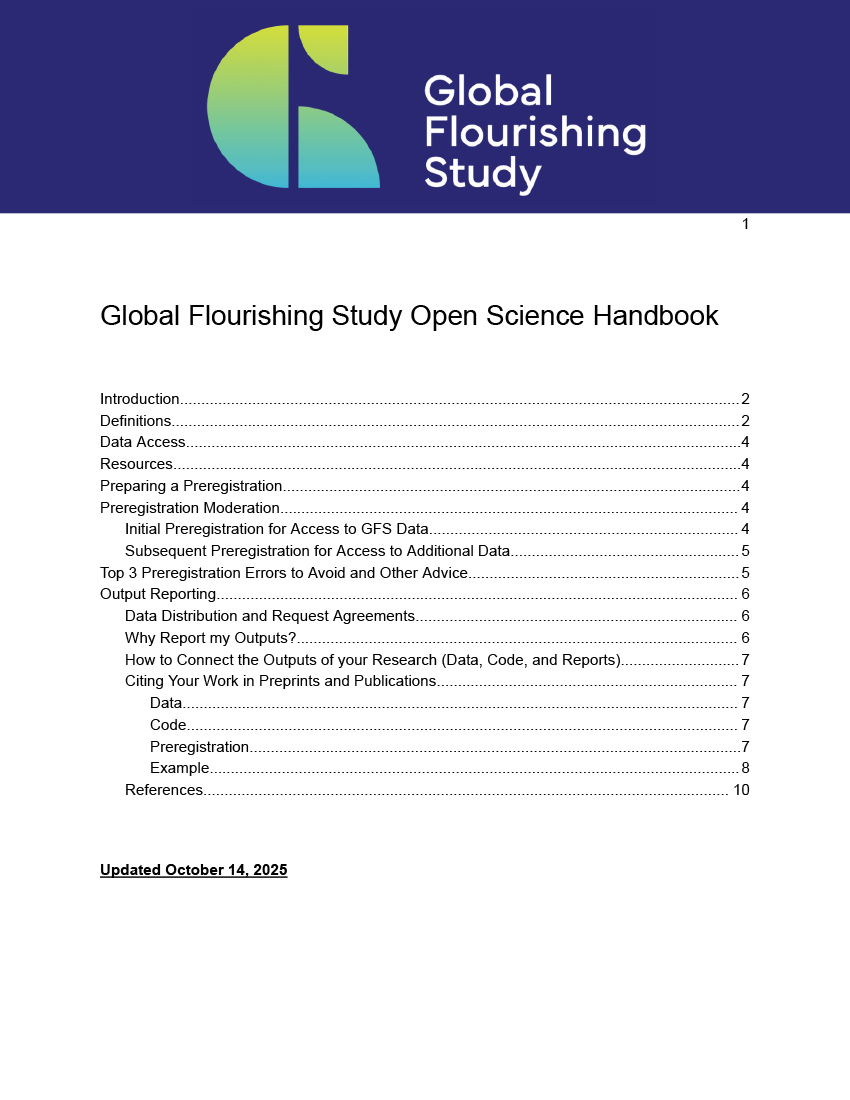
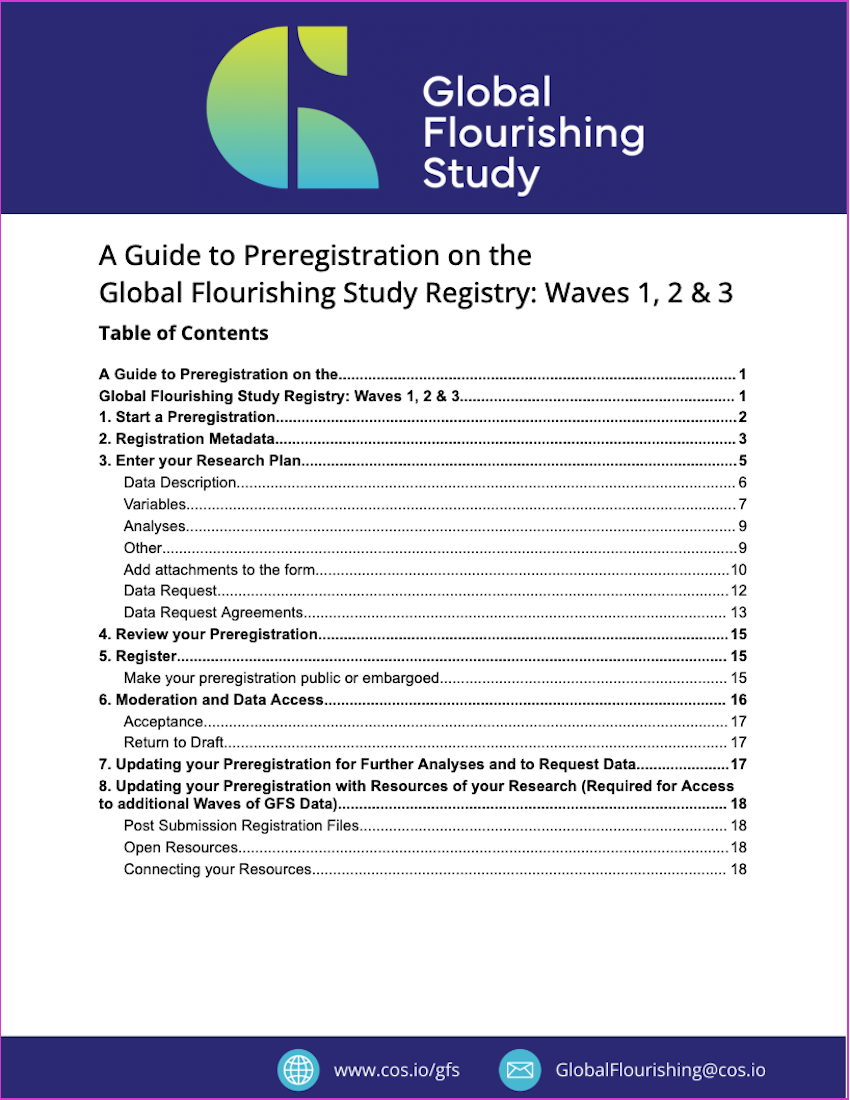
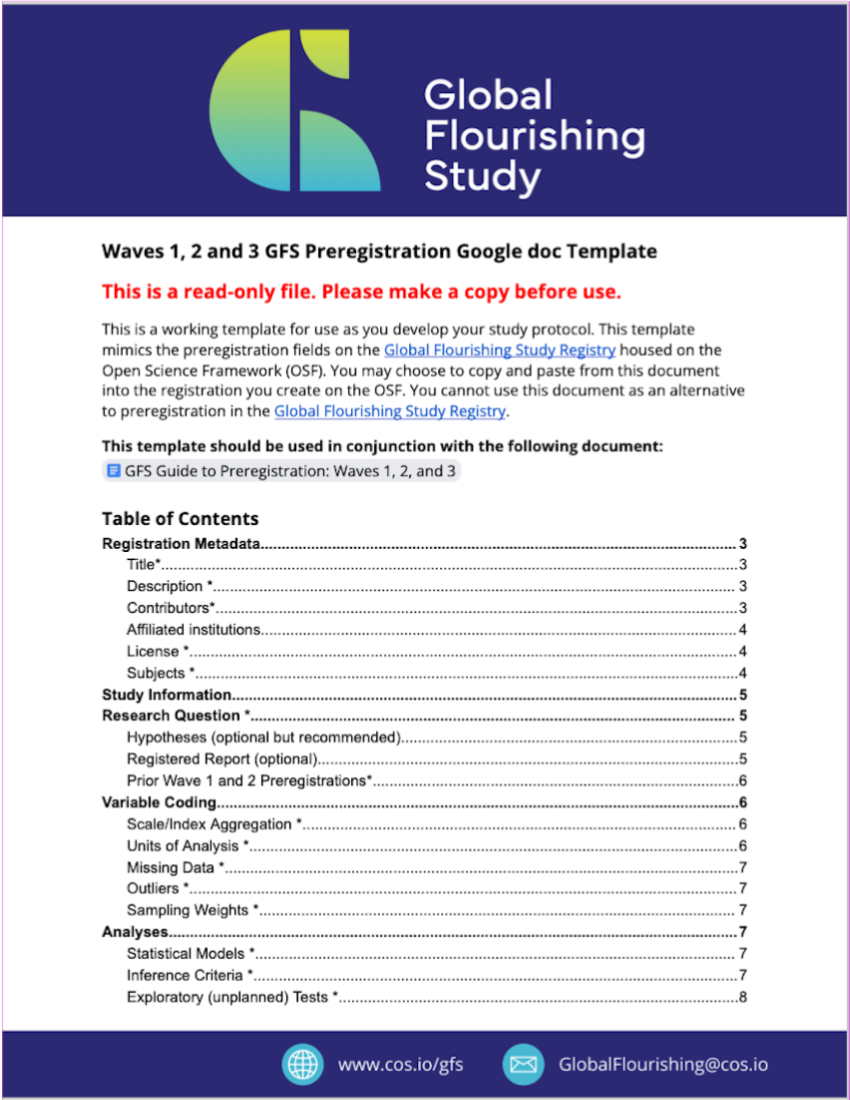
Use the Global Flourishing Study Handbook to learn how to complete a preregistration to access the GFS data, and review additional documents below:
Accessing Reports and Research
For a list of public registrations that contain details of planned research, visit the GFS Registry. Scroll through the registrations or add search terms to narrow your search. You can also refine your search by using the menu in the left hand column. The colored open resource badges will take you to links for data, code, and draft papers (preprints) or journal articles.
Visit the public GFS website to find out more about the study and search the work of the core research team.
Not sure where to start? Check out GFS resources to answer key questions and find step-by-step guidance.
The GFS is a collaboration between researchers from the Institute for Studies of Religion at Baylor University and the Human Flourishing Program at Harvard University, in partnership with Gallup and the Center for Open Science.
The GFS is generously funded by the John Templeton Foundation, Templeton Religion Trust, Templeton World Charity Foundation, Well-Being for Planet Earth, Fetzer Institute, Well Being Trust, Paul L. Foster Family Foundation, and the David & Carol Myers Foundation. The Center for Open Science is funded through a contract from Baylor University.


6218 Georgia Avenue NW, Suite #1, Unit 3189
Washington, DC 20011
Email: contact@cos.io

Unless otherwise noted, this site is licensed under a Creative Commons Attribution 4.0 International (CC BY 4.0) License.
Responsible stewards of your support

COS has earned top recognition from Charity Navigator and Candid (formerly GuideStar) for our financial transparency and accountability to our mission. COS and the OSF were also awarded SOC2 accreditation in 2023 after an independent assessment of our security and procedures by the American Institute of CPAs (AICPA).
We invite all of our sponsors, partners, and members of the community to learn more about how our organization operates, our impact, our financial performance, and our nonprofit status.